
Commercial construction loans solve this problem, but they don't work like a standard mortgage. Instead of one lump-sum payout, funds are released in stages as the project hits specific milestones. That structure protects both the lender and the borrower, but it also means the qualification process, cost structure, and timeline look very different from a typical commercial real estate loan.
This guide covers how construction loans work, the types available, what they cost, how to qualify, and how to pick the right lending partner for your project.
Key Takeaways
- Funds release in stages tied to verified construction milestones, not all upfront
- Interest during construction is charged only on disbursed funds, not the full loan amount
- Down payments typically run 10%-30% of total project cost depending on lender type
- DSCR-based investor programs can open doors for borrowers without strong personal income documentation
- Choosing a lender means weighing draw speed and flexibility, not just the advertised rate
What Is a Commercial Building Construction Loan?
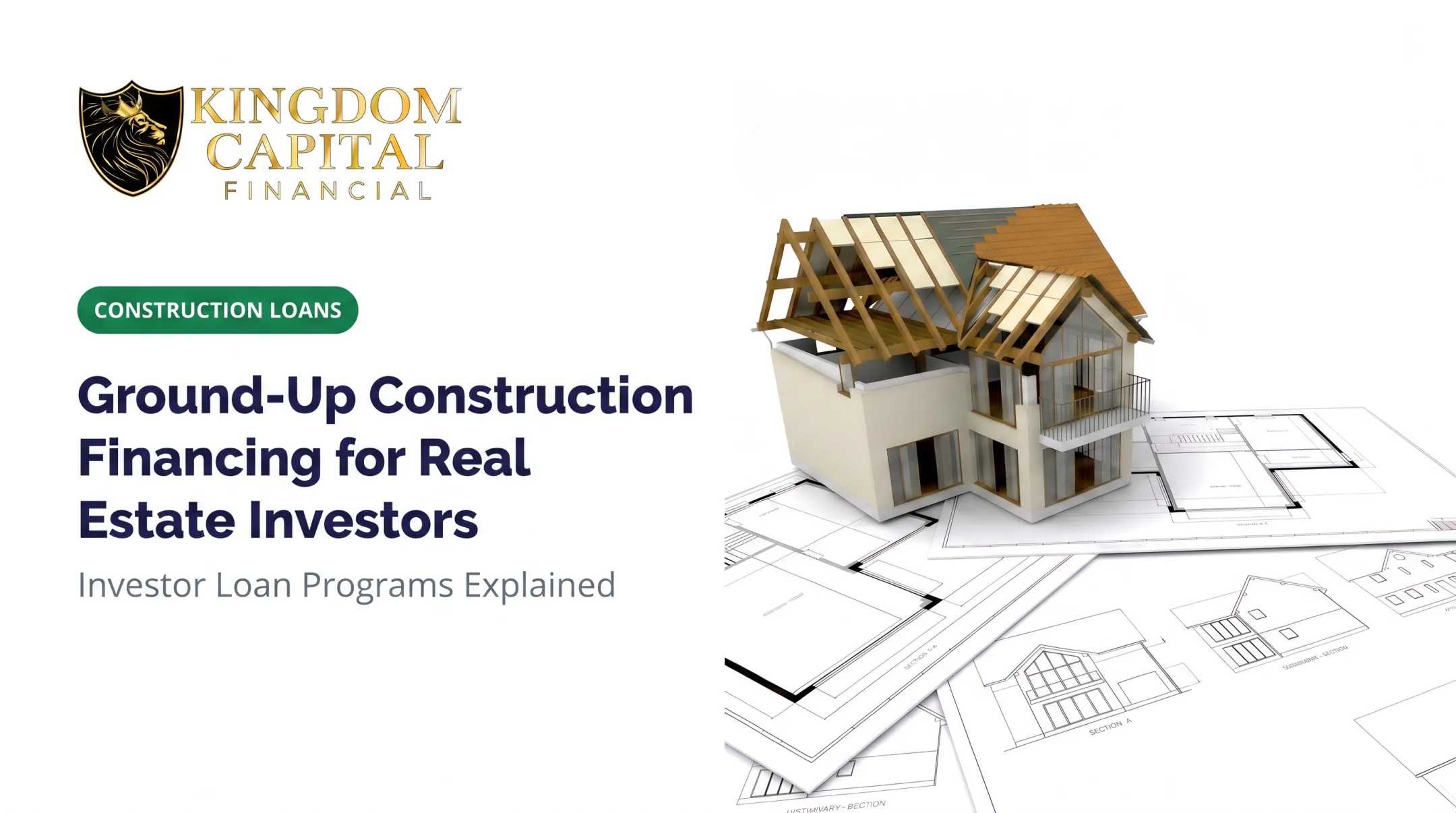
A commercial construction loan is short-term financing used to build a new commercial property or renovate an existing one. It covers land acquisition, permitting, labor, and materials throughout the build.
The defining feature is completion-dependent repayment. According to the OCC's Commercial Real Estate Lending handbook, construction loans finance the creation of the collateral itself, with repayment tied to the project getting built.
A standard commercial mortgage, by contrast, finances an asset that already exists and generates cash flow.
Key structural difference:
- Standard mortgage: full funds disbursed at closing
- Construction loan: funds released in stages, tied to verified progress
This financing applies across commercial property types such as:
- Office buildings and retail centers
- Multifamily developments
- Industrial and warehouse space
- Mixed-use projects
Kingdom Capital Financial's network arranges ground-up development financing for multifamily and commercial properties, from pre-development through completion and stabilization.
How Commercial Construction Loans Work
The Draw Schedule
Instead of a single payout, construction loans use a draw schedule. Funds release after each verified milestone, such as land grading, foundation work, or framing. An inspector or loan administrator confirms the work is done before the lender releases the corresponding payment.
Example draw request scenario: A developer completes foundation work and submits a draw request for that phase. The lender sends an inspector to verify progress, the title company confirms no new liens exist, and the contractor submits lien waivers from subcontractors. Only after all three checks clear does the lender release funds for that milestone.
A word of caution on draws: Out-of-turn or unverified draw requests can leave a project underfunded mid-build. Lenders also typically retain 10%–20% of each payment as a holdback for overruns, so tight draw monitoring protects your schedule and budget.

Who's Involved
Construction loans typically involve several parties working together:
- Borrower — manages the project and submits draw requests
- Lender — reviews and disburses funds against verified progress
- Title company — updates the title policy with each draw and confirms no outstanding liens
- General contractor — completes work and provides lien waivers
- Borrower's attorney/CPA — reviews loan documents and financial structuring
Interest-Only During Construction
Here's the part that surprises a lot of first-time borrowers: you're not paying interest on the full loan amount from day one. You only pay interest on funds actually disbursed. Per NEBAT's business construction loan guide, that interest-only-on-disbursed-funds structure is standard across commercial construction lending.
What Happens at Completion
Once construction wraps up, the loan does one of two things:
- Converts to permanent financing (construction-to-permanent), rolling into a standard commercial mortgage
- Requires a separate takeout loan to pay off the construction debt
A takeout commitment can be arranged before or after completion and lease-up. Don't assume your construction loan automatically becomes your permanent mortgage—confirm the conversion terms before you close.

Types of Commercial Construction Loans
Different borrowers fit different loan structures. Here's a breakdown:
| Loan Type | Best For | Key Considerations |
|---|---|---|
| Bank/credit union | Established businesses, strong credit | Competitive rates; stricter qualification; slower process |
| SBA 504/7(a) | Owner-occupied construction/renovation | Caps around $5M–$5.5M; terms up to 25 years; excludes speculative projects |
| Hard money/private | Borrowers needing speed | Higher rates; shorter terms; refinance risk |
| Investor-focused ground-up construction | Investors/developers without strong W-2 income | Qualification based on project viability and value |
| Mini-perm/mezzanine | Bridging construction to permanent; filling equity gaps | Mezzanine sits behind senior debt; higher pricing |
SBA programs offer longer repayment terms but come with restrictions. SBA 504 loans, for example, can't fund passive or speculative activities and typically require the borrower to occupy the property.
Hard money and private construction loans work on an asset basis. If your credit doesn't check every conventional box or you're racing against a closing deadline, this route trades a higher rate for speed.
Investor-focused ground-up construction financing evaluates the property, borrower, project, and exit strategy rather than relying solely on personal income or tax returns. Kingdom Capital Financial's network arranges this financing for real estate investors and developers who don't fit the traditional bank mold but have a solid project and clear exit plan.
Mezzanine financing layers behind the senior construction loan to boost leverage without replacing it. It's useful for experienced sponsors trying to reduce their equity contribution on a larger project.

Commercial Construction Loan Costs: Rates, Down Payments & Fees
Interest Rates
Rates vary widely based on lender type, borrower creditworthiness, and project risk. Published lender examples include:
- Conventional bank construction loans: roughly 4%–12%
- Private/hard-money lenders: 9%–14%, per Avana Capital's hard money lending guide
- SBA loans: priced against a base or prime rate with published maximum spreads
These figures are lender-specific examples from published guides, not universal averages. Always get a current, written quote for your specific project.
Down Payments
Expect to bring 10%-30%+ of total project cost, depending on lender type:
- Banks: often 10%-25% down
- Hard money: typically 20%–40% down (60%–80% LTV)
- SBA 504: as little as 10% borrower equity in eligible structures
Monthly Payments
During construction, payments are interest-only on disbursed funds. Once the loan converts to permanent financing, payments jump to a fully amortized structure covering principal and interest on the full loan balance. That jump can catch borrowers off guard if they haven't modeled it in advance.
Fees to Expect
- Origination fees: usually a percentage of the loan amount, due at closing
- Appraisal fees: third-party valuation required before the lender commits
- Inspection/draw fees: charged each time a construction milestone is verified
- SBA guarantee fees: apply when an SBA guarantee is part of the structure

Qualifying for a Commercial Construction Loan
Lenders look at more than just your credit score. Core requirements typically include:
- Credit score thresholds: lender-specific guidelines often cite high-600s to low-700s for personal credit
- DSCR expectations: commercial lenders commonly look for 1.25x to 1.4x, though this varies by lender and property
- Detailed project documentation: plans, contractor agreements, and a full budget breakdown
Lenders generally prefer borrowers with prior development experience. That said, alternative programs can open doors for investors who don't fit that mold. DSCR-based investor loans, for instance, qualify borrowers based on projected property cash flow rather than personal income or tax returns. Kingdom Capital Financial's broader investor programs accept credit scores as low as 575.
Document checklist:
- Business plan or project summary
- Detailed cost breakdown (land, hard costs, soft costs)
- Permits and zoning approvals
- Contractor bids and agreements
- Financial statements for borrower and guarantors
Choosing the Right Construction Lending Partner
The lowest advertised rate isn't always the best deal once you factor in draw delays, inspection fees, and how a lender handles a project that hits a snag. For time-sensitive builds, working with an experienced, investor-focused lending network often matters more than chasing a headline number.
Kingdom Capital Financial's nationwide network of investor loan partners offers construction, DSCR, bridge, and SBA financing for investors and business owners. Pre-qualification support evaluates the property, borrower, project, and exit strategy together.
Team members like Santino Salanitri focus specifically on ground-up construction and commercial loans, working alongside processing specialists like Hahn Montalvo to keep applications moving.
Before committing to any lender, compare:
- Responsiveness — how quickly they answer questions during underwriting
- Draw processing speed — how fast funds release once a milestone is verified
- Flexibility on collateral types — whether they accommodate multifamily, retail, industrial, or mixed-use projects
Frequently Asked Questions
What is the monthly payment on a commercial construction loan?
During construction, you pay interest only on funds actually disbursed, not the full loan amount. Once the loan converts to permanent financing, payments increase substantially since they now cover principal and interest on the full balance.
How much down payment is required for a commercial construction loan?
Down payments typically range from 10% to 30%+ of total project cost. Banks often require 10%-25%, while hard money lenders may need less cash down but charge higher rates in exchange.
What are the typical interest rates for commercial construction loans?
Rates vary by lender type: conventional banks have historically ranged roughly 4%-12%, while private and hard-money lenders often run 9%-14%. Your specific rate depends on creditworthiness and project risk.
Is it hard to qualify for a commercial construction loan?
Traditional lenders want strong credit, development experience, and detailed project documentation. However, DSCR-based investor programs offer flexible alternatives for borrowers with lower credit scores or limited traditional income documentation.
How long does it take to get approved for a commercial construction loan?
Traditional bank applications can take 60-90 days or more, while some investor-focused networks close in a shorter window depending on how quickly documentation is provided. Completeness of your project package speeds things up considerably.
Can I convert a construction loan into permanent financing?
Some programs offer construction-to-permanent conversion, rolling directly into a standard mortgage after completion. Others require a separate takeout loan, so confirm which structure applies before you close.